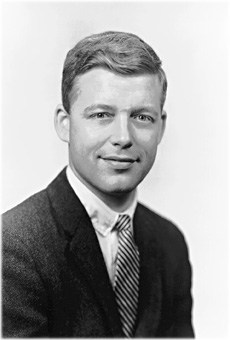
– Bob Taylor
The IPTO funded the research that led to the development of the ARPANET. It was variously headed over the years by Licklider, Sutherland, Taylor, and Roberts as described below.
Licklider. In 1962, Jack Ruina, Director of ARPA, hired J.C.R. Licklider to be the first Director of the new Information Processing Techniques Office (IPTO). The original mandate of the office was to extend the research carried out into computerization of air defense by the SAGE program to other military command and control systems. In particular, the IPTO was to build on SAGE’s development of one of the first wide-area computer networks for the cross country radar defense system, and build a survivable electronic network to interconnect the key DoD sites at the Pentagon, Cheyenne Mountain, and SAC HQ. This was long before the cable and fiber networks we have access to today.
The IPTO funded research into advanced computer and network technologies, and commissioned thirteen research groups to perform research into technologies related to human-computer interaction and distributed systems. Each group was given a budget thirty to forty times as large as a normal research grant, complete discretion as to its use, and access to state-of-the-art technology at the following institutions:
- Carnegie-Mellon University
- MIT
- RAND Corporation
- Stanford Research Institute
- System Development Corporation
- University of California at Berkeley, Santa Barbara, and Los Angeles
- University of South Carolina
- University of Utah
In 1963, Licklider funded a research project through the IPTO, headed by Robert Fano at MIT called Project MAC, which explored the potential for establishment of communities on time-sharing computers. The project monitored the interactions between a community of users using time-shared communication and found that the technology encouraged the establishment of real, if somewhat unique, electronic relationships among people across distances. This example had a lasting effect on the IPTO and wider research community as a prototype of the benefits of widespread networking.
Licklider’s vision of a universal network greatly influenced his successors at the IPTO, Ivan Sutherland, Bob Taylor, and MIT researcher Lawrence Roberts, and shaped the subsequent research that led to development of the Internet.
Sutherland. In July 1964, Licklider went to work for IBM, and handed over directorship of the IPTO to its second Director, Ivan Sutherland, who had created the revolutionary Sketchpad program for storing computer displays in memory where they could be modified, processed, copied, and redrawn. Sutherland’s program enabled the creation of the field of computer graphics that has led to all the graphical displays available today.
In 1965, Sutherland gave Lawrence Roberts at MIT an IPTO contract to further develop the technology of computer networking. Roberts and Thomas Merrill then implemented the first packet exchange by dial-up telephone connection, between a TX-2 computer at MIT and a Q-32 computer in California.
Taylor. In 1966, Sutherland handed over directorship of the IPTO to its third Director, Robert Taylor, who had been powerfully influenced by Licklider, and was coincidentally (like Licklider) a researcher in psychoacoustics.
Taylor had three different terminals in his IPTO office to connect to three different research sites and realized this architecture would severely limit his ability to scale access to multiple sites. He dreamed of connecting a single terminal to a network with access to multiple sites, and from his position in the Pentagon, he could lobby for the funding to implement it the vision.
In 1966, DARPA head Charlie Hertzfeld promised Taylor a million dollars for the IPTO to build a distributed communications network if he could get it organized. Taylor was impressed by Robert’s work and asked him to come on board to led the effort. When Roberts resisted, Taylor asked Hertzfeld to get the Director of Lincoln Labs to pressure Roberts to reconsider, which eventually caused Roberts to relent and join the IPTO as Chief Scientist in December 1966.
When Roberts gave the report titled Resource Sharing Computer Networks describing the plan to build the ARPANET to Taylor on June 3 1968, Taylor approved it 18 days later on June 21, leading directly to the ARPANET’s creation fourteen months later.
Roberts. Three years later when the ARPANET was well on its way, Taylor handed over directorship of the IPTO to Roberts in September 1969.
Licklider. When Roberts left ARPA to become CEO of Telenet, Licklider returned again as IPTO Director in October 1973, to complete the organization’s life cycle.